
Control boards sit inside the unit's electrical compartment, which is a sealed, protected environment. In practice, most compartments are not airtight, and condensation forms inside whenever warm, humid air meets a cooler surface, which happens constantly around refrigerant lines and cold coil sections.
Sustained humidity alone is enough to begin a slow damaging process to the board: moisture in the air reacts with exposed metal — solder joints, relay contacts, connector pins — forming a thin layer of oxidation. That oxidation increases resistance at dozens of tiny points across the board simultaneously, rather than at one obvious terminal the way a loose high-voltage connection would.
The failures this produces are notoriously hard to diagnose because they're often intermittent and don't map cleanly to a single component: a relay that sometimes doesn't energize, a sensor input that reads erratically, a board that resets on its own during humid weather and behaves normally once it dries out. Technicians unfamiliar with a specific board sometimes replace it outright rather than identify corrosion as the actual cause — an expensive fix for what corrosion cleaning and a moisture source correction could have resolved.
Visually, the signs are a greenish or white powdery residue around solder joints and connector pins, a faint musty smell inside the electrical compartment, or a slight haze on the board's surface compared to its original glossy coating. None of these show up unless the technician actually removes the panel cover and looks at the board directly, rather than relying on the unit's behavior alone.
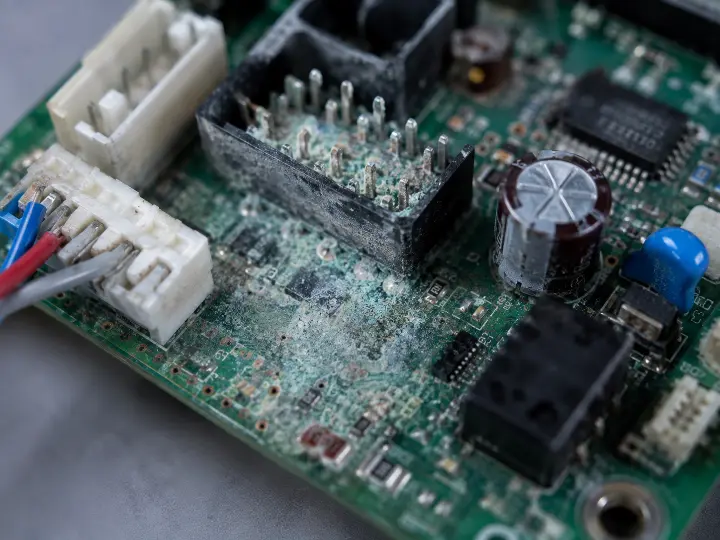
Because the underlying cause, the humidity, is not something a quick glance reveals, this check tends to get the "board looks fine" as a default answer. Newer boards with a conformal coating resist this far better than older, uncoated ones. Hence, this is worth knowing when deciding whether a recurring intermittent fault is worth a board upgrade rather than another cleaning.
For a property manager: ask whether the technician visually inspected the board for corrosion.