
Manufacturers rate a properly installed and maintained split or cassette system for twelve to fifteen years of service. But property managers' actual replacement age looks closer to seven or eight years. That gap isn't explained by product quality — the same compressor, installed and maintained in two different ways, produces two different lifespans. The gap usually boils down to three things.
The first is Baseline: whether the unit was ever measured against its own day-one baseline. A system commissioned correctly has day-one readings: static pressure, refrigerant charge expressed as superheat and subcooling, and amperage draw under load. A unit serviced against a checklist ("filter cleaned," "coil rinsed," "unit operational") is fulfilling the basics. A unit serviced against its own baseline gives a far more useful insight.
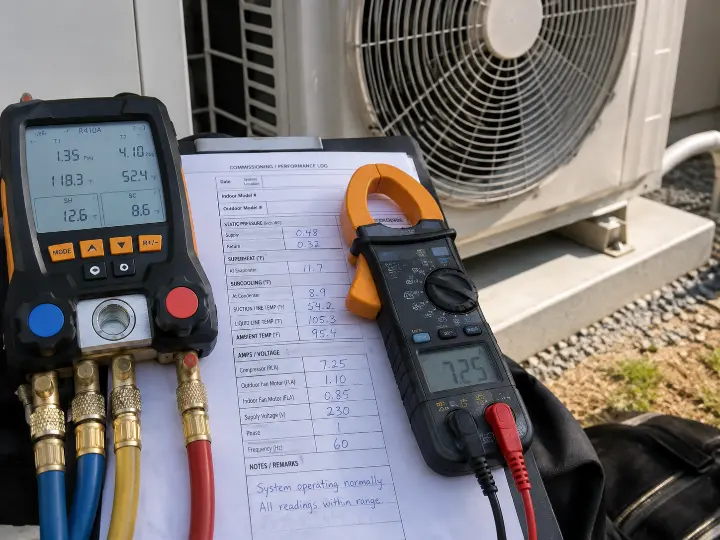
The second is Load Stress: whether load stress gets addressed before it becomes damage. Temporary abnormal load is acceptable — a blocked outdoor unit or a space that's been repurposed and now runs hotter than the system was sized for. What kills the unit is that load stress persisting for months because nobody was tracking amperage draw and seeing it drift from baseline. A unit that reaches fifteen years is one where load stress got caught and corrected within weeks, not years.
The third is Data Trend: whether repairs get treated as data points or as isolated incidents. A capacitor failure at year four is a repair. But it is also a signal — capacitors fail early when they're running outside their rated tolerance, which usually points to a voltage or load issue elsewhere in the system. Replace the capacitor and ask why it failed early, and you catch the underlying condition years before it presents as a compressor failure.
None of these three practices cost much more than the alternative. A baseline reading, a load stress review, and a premature part failure takes minutes to log and ask. What they require is a maintenance relationship built around the assumption that the unit is an asset to be maximized.
The portfolios that consistently see fifteen-year lifespans aren't spending dramatically more per unit than the portfolios replacing at year seven. They're spending the same money differently — on visits that produce a record instead of a checklist, and on a habit of recording small failures as information about the system rather than isolated repairs to close out.
Field Note
Ask your current vendor for the baseline readings from your units' first service visit. If that record doesn't exist, there's nothing for today's readings to be compared against — and no way to know which of your units are aging on schedule.