
Every running compressor and fan motor vibrates, and every wire routed near one moves with it — a fraction of a millimeter per cycle, thousands of cycles a day, for years. Where a wire passes through a sheet-metal panel, rests against a mounting bracket, or bundles tightly against a refrigerant line, that tiny repeated movement acts like sandpaper on the wire's insulation.
Manufacturers use rubber grommets at panel penetrations and cable ties that route wiring away from sharp edges and moving parts. Both grommets and cable ties wear out or shift over time. A grommet that's hardened and cracked, or a cable tie that's snapped and let a wire bundle sag against a metal edge, removes the protection.
A short circuit, a tripped breaker, or a blown fuse, often happens on a hot afternoon when the unit is cycling the hardest. Unlike a loosening terminal, this failure mode gives almost no operational warning beforehand. Once insulation wears through far enough to expose bare conductor against a grounded metal chassis, the result is usually immediate and dramatic.
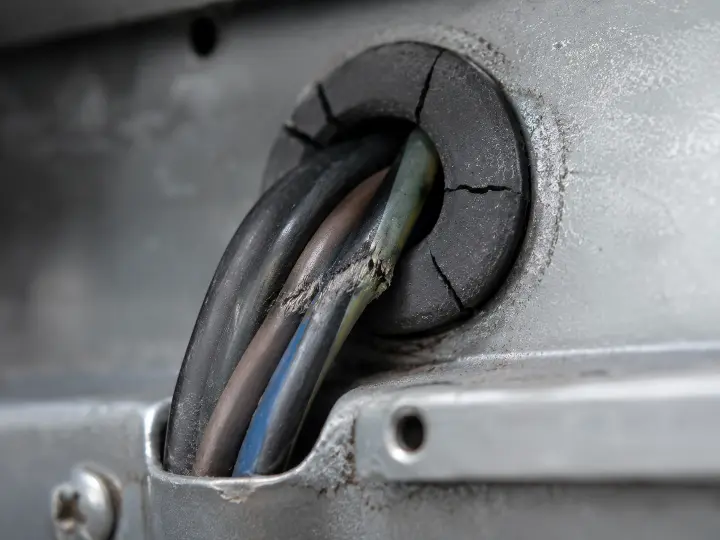
Tracing accessible wiring runs by hand, feeling for insulation that is brittle, and specifically checking every point where a wire passes through metal or lies against a refrigerant line or bracket edge. It is a tactile and visual check.
The units most at risk are the older compressors with old worn mounts, or units installed on rooftop curbs where wind adds a second source of movement on top of the compressor's own movement.
Vibration, cracked insulation, gradually, short circuits.