
Property managers tend to assume that when a unit stops responding to the thermostat, the problem is something substantial like a failed board. There may be a simpler possibility — the low-voltage control wiring that links the thermostat to the control board.
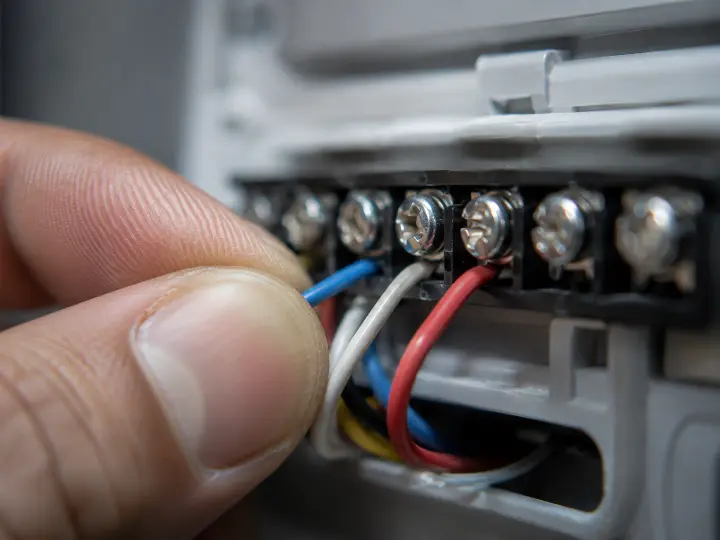
This control wire typically runs on 18- or 24-gauge wire at 24 volts. How does it fail? The screw terminals on control boards are small, the stripped wire ends are thin, and a connection that wasn't seated firmly during the last service call, or that was nudged during a filter change or panel access, can go from "working" to "intermittent" with almost no visible sign.
When this happens, the system works fine during the visit, then drops a call for cooling or heating randomly, often correcting itself before anyone can diagnose it — which is why so many of these show up on service history as "no fault found."
The check: gently tugging on each low-voltage wire at both the thermostat and board ends to confirm that it is actually seated under the screw head, not just resting against it. A wire that pulls free with light pressure, or a screw terminal with visible corrosion on the exposed copper, is a connection on its way to failing.
Because these connections rarely produce a visible symptom, they are easy to be considered a non-issue. Compared to the high-voltage side of the panel, they are not obvious, yet they are responsible for a large share of callback visits.
For a property manager: if a unit has a history of intermittent "works when the tech arrives" complaints, ask specifically whether the low-voltage terminals were tested for a firm connection.