
Most of the readings that matter in a maintenance visit — refrigerant charge, amperage draw, static pressure — require a gauge, a clamp meter, or a manometer, and they show up on a service report as a number.
There's one check that predicts long-term failure: a close visual and tactile inspection of every electrical terminal and connection point in the unit, checked for discoloration, looseness, and the specific kind of pitting that indicates arcing has already begun. It takes about five minutes.
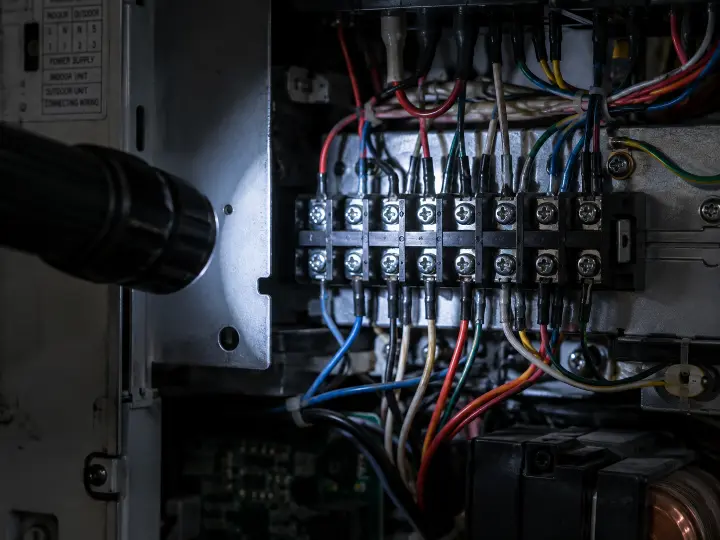
It's also the check most likely to be skipped, because unlike a refrigerant reading, there's no simple number to write on the report — it comes from concern and thoroughness.
Connection points loosen gradually through thermal cycling, the repeated expansion and contraction when a unit starts and stops. A loosening connection:
- increases electrical resistance at that point.
- which generates localized heat.
- which accelerates further loosening
- which leads to oxidation of the contact surface
— a feedback loop that ends in a failed connection, a tripped breaker, or in more severe cases, a compressor pulling abnormal starting current against a degraded circuit and failing prematurely as a result.
The entire process, from a slightly loose connection to a point where it's causing measurable damage, typically unfolds over months to a few years — which means a five-minute inspection, performed consistently, catches it with enormous lead time.
The visual signs that a trained technician identifies:
- a terminal with a faint discoloration — a light bronze or blue tint on copper, or darkening on a lug — indicates it's been running hotter than its neighbors, which almost always means resistance has increased there.
- a connection that shows room for movement (a play) when gently tested with an insulated tool.
- fine black or gray pitting on a contact surface, which means the connection is actively degrading each time the unit cycles.
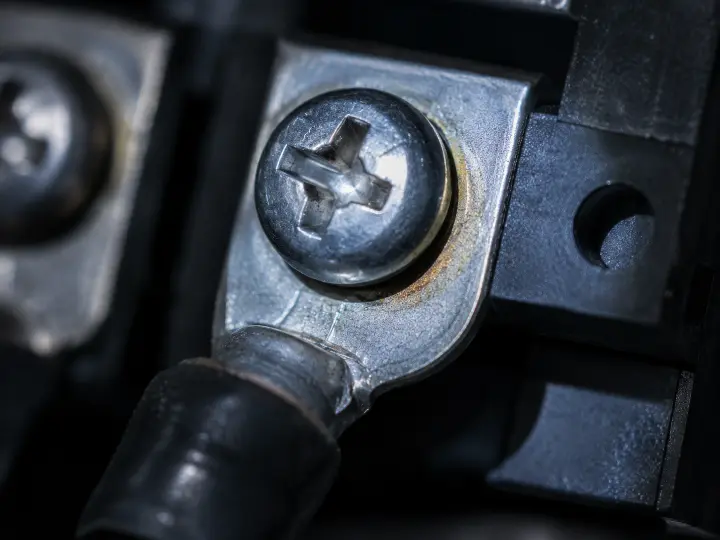
What makes this check easy to skip is also what makes it valuable: it doesn't produce a clean number for a report, it requires the technician to actually open the electrical panel and look closely. A rushed visit, or a technician working through too many units in a day, will complete the visible tasks — filter, coil, refrigerant check — and skip this one.
For a property manager, the value of this arcing check is in remembering to ask about it. Ask your technician to show you. A vendor technician who can point to one, or confidently say there are none, is actually performing this check. A vague "everything looked fine" usually means they aren't.