
It is tempting to remove coil cleaning from the invoice. The unit still runs. It still blows cold air. Nothing trips, nothing alarms, and the invoice looks a little lighter without it. This is true especially on a property with several units and a maintenance budget already stretched thin across all of them.
The evaporator coil's fins are built to maximize surface area for heat transfer, which also makes them extraordinarily good at trapping dust, lint, and airborne grease. A coil that looked like a clean metal grid at installation gradually fills in with that layer of dust as air passes through it hourly.
That insulating layer reduces heat transfer a little at a time. That means coolness from the copper coil to the hotter room air is restricted. For example, an efficient thermostat setpoint drop of 5 degrees Celsius might require 5 pump cycles. When the coil fins are insulated by dirt, that same 5 degrees Celsius needs 7 pump cycles to be achieved.
The compressor compensates for this by running longer — in this case, pumping 2 more cycles — to hit the same target thermostat setpoint. Longer run time? More electricity consumed for the same cooling output, every single day until the coil is cleaned.
The feedback loop compounds in two directions at once. A fouled coil reduces heat transfer, which lengthens compressor run time, which increases wear alongside higher electricity cost.
Industry studies and manufacturer data consistently put the efficiency penalty from coil fouling in the range of 10-30% — meaning a unit with a badly neglected coil can be costing 20% more to run every single day, without ever showing up as a fault.
Set against that ongoing cost, the cleaning itself now looks inexpensive.
For a property manager planning to trim a maintenance budget: coil cleaning is one of the worst candidates for removal, because its cost is asymmetric. The cleaning bill is fixed and small, while the hidden increase in the electricity bill increases without control.
Not every coil cleaning is the same task, either, and it's worth knowing which one is being performed. A lightly soiled coil may only need a simple rinse with water or a mild cleaner. A heavily fouled coil needs a proper foaming coil cleaner and brush work to actually penetrate between the fins.
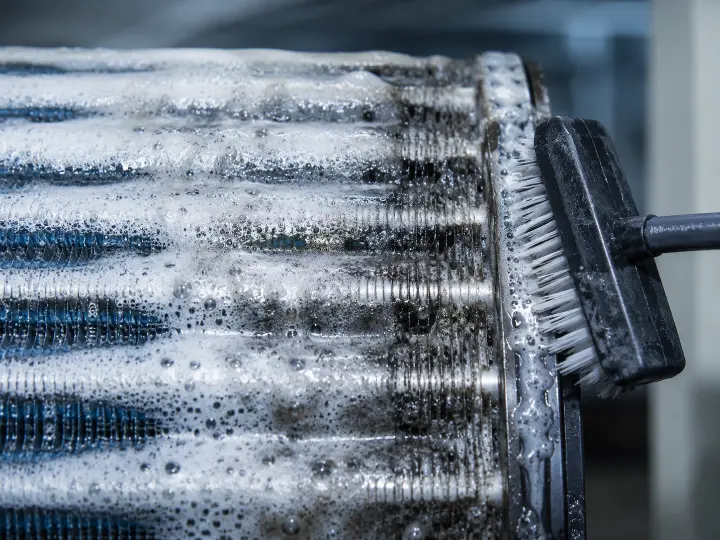
A technician who applies the same quick treatment regardless of how fouled the coil is will be cleaning the visible face without removing the buildup. That buildup continues to restrict airflow between the fins and causes inefficient heat transfer.
A unit serving a space near a kitchen exhaust, a loading dock, or heavy foot traffic also accumulates fouling much faster than one serving a clean office interior, and their cleaning schedules should reflect that difference.