
Every cooling cycle pulls water moisture out of the room air, cools it into water, and deposits it in the evaporator's condensate pan, where it's meant to drain away through a condensate line. That pan sits in a dark, damp environment — precisely the conditions algae, mold, and bacterial slime need to thrive.
Left uncleaned, that biological growth — "the jelly-like film" — doesn't stay contained to the pan. It sheds material that travels into the condensate line itself, gradually narrowing and blocking the drain line path.
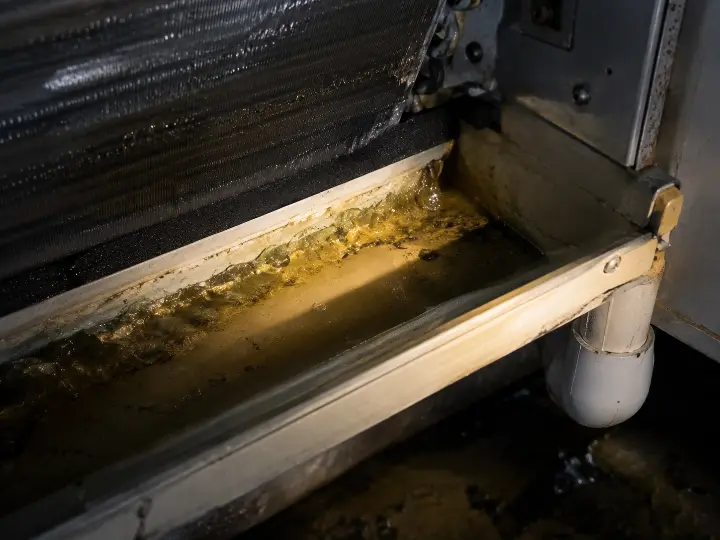
A partially restricted line drains slower than it fills during heavy cooling cycles, the situation that precedes an overflow.
When a primary drain clogs completely, water overflowing travels downward through ceiling tiles, insulation, and drywall. Commercial water damage claims tied to condensate overflow make cleaning the drain pan look like the smallest task on the invoice.
Checking this properly means physically inspecting the pan for standing water, algae growth, or debris, and flushing the condensate line with the appropriate cleaner or a wet vacuum to confirm it drains freely.
For a property manager: this is one of the clearest expense-versus-risk comparisons in the entire maintenance plan. A pan cleaning costs a fraction of what a single water damage incident costs, and unlike most maintenance items, the downside of skipping it isn't a gradual efficiency loss — it's a specific, sudden, and expensive failure with a clear trigger.
There is also another problem to this: standing water and biological growth in a condensate pan contributes to indoor air quality complaints, and a musty smell traced back to an aircon unit's drain pan.