
The blower wheel is the component that moves air across the coil and out into the space. Unlike the filter directly in front of it, which gets checked and swapped on a visible schedule, the blower wheel sits inside the cabinet and rarely gets a second thought.
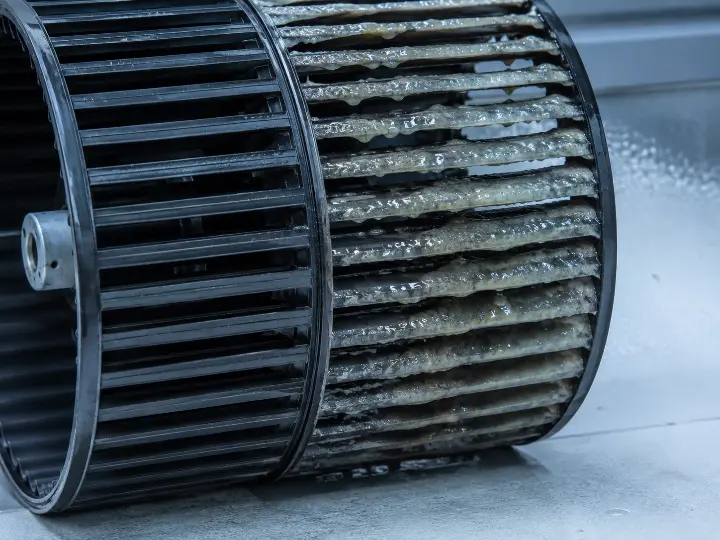
Even with a filter in place, a certain amount of fine dust and dirt makes it past the filter media and onto the blower blades. Not just that, the wet environment inside the cabinet makes bacteria and algae flourish inside. Called biofilm, this outgrowth is the biofilm's waste products, in jelly-like form.
A blower wheel caked with buildup can lose a substantial share of its rated airflow while still spinning at full speed and drawing close to normal amperage. The motor looks fine. The air simply isn't moving the way it should. Every downstream system connected to that airflow quietly compensates and degrades in response to this "harmless" biofilm buildup.
That's the expensive part of skipping this cleaning. In technical terms, reduced airflow at the blower cascades into:
- reduced evaporator performance,
- which raises suction pressure and superheat,
- and forces the compressor to run longer for the same result,
- functionally the same financial and mechanical consequences described for a dirty coil
Cleaning a blower wheel properly means pulling it from its housing, or accessing it in place with the right tools, and physically removing the buildup from each blade — a more involved job than wiping down an accessible coil face.
For a property manager: ask when the blower wheel was last removed and cleaned, not just when the filter was last changed.
There's a mechanical cost stacked on top of the airflow cost as well: buildup rarely accumulates evenly across every blade, and an unevenly loaded wheel spins slightly out of balance, generating vibration that wasn't present when the wheel was clean.
That vibration transmits into the motor's bearings over time, accelerating bearing wear. A cleaning task deferred for budget and convenience turns into a contributor toward an eventual motor replacement.
That's a reasonable justification for the extra labor time it adds to a visit, and worth understanding rather than treating as padding on an invoice.