
A compressor about to fail looks like every other compressor in the building. Whatever's going wrong is happening inside a sealed unit nobody can see into. No visual inspection catches it.
But one number does: amperage draw.
Every motor pulls a specific amount of current to do a specific amount of work. A healthy compressor draws a predictable amount of power indicated in the manufacturer’s label. When something starts going wrong inside it — a bearing wearing down, a winding starting to short — the motor works harder to do the same job. It pulls more current. That increase shows up in amperage draw months before it shows up as a failure.
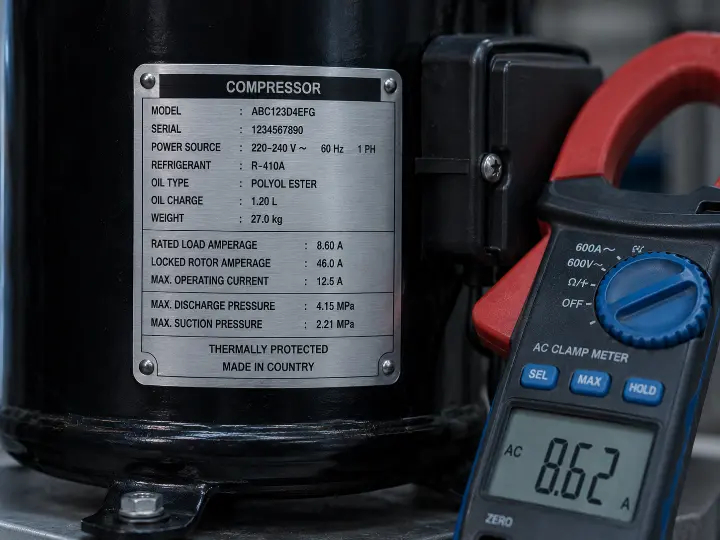
The increase starts small. A percent or two above baselines. Nobody would notice it by ear, or by touching the unit, or by watching it run. It only shows up if you're comparing today's reading against a baseline.
This is why the number beats a visual check. A visual inspection catches things already visible: a burn mark, a leak, a loose panel. By the time a compressor problem is visible, it's usually already failed.
Amperage draw catches the buildup before that — sometimes six months before, sometimes longer.
Reading it right needs two things: a clamp meter, which any technician already carries, and a baseline to compare against. Neither is complicated. The part usually missing is the second one. Not because it's hard — because it means taking the same reading, logged, at every single visit, and being able to access past logs. Most programs don't require that.
Compressors have a normal range, and a single reading inside that range looks fine. The value is in the log trend. A flat reading for two years that jumps three percent in one quarter is telling you something happened. A reading climbing slowly for a year is telling you something else — a slow decline that, left alone, usually ends in failure.
Once the trend shows, there is real time to act. A compressor three percent over baseline isn't failing tomorrow. It's entering a decline that typically ends within a year or two. That's enough time to plan a repair, source a part, or budget a replacement — instead of finding out on the hottest day of summer.
It needs a technician who takes the reading every visit, logs it against the same baseline, and flags it when it moves.
FIELD NOTE
Ask for your units' amperage baselines from commissioning. If nobody has them, today's reading has nothing to compare against.