
A service report looks like documentation nowadays. In Manila, it has often become an attendance slip that a technician showed up. It doesn't prove the unit is healthy.
A typical report is a list of tasks: filter checked, coil cleaned, refrigerant level normal, unit operational. Every box checked. Every line the same as last quarter. That sameness feels reassuring. It shouldn't. A healthy unit and a slowly failing one can produce the same report for years — right up until the year they don't.
The gap is what's missing from the page. Most reports skip numbers and use status words instead. “Normal” isn't a measurement. It's a fast judgment call.
Reports also rarely show trend. Even a report with a real number means little without last quarter's number beside it. A pressure reading of 68 psig could be exactly where it should be. Or it could be down from 74 psig last visit, heading toward a leak nobody's found. One number alone can't tell you which.
And most reports don't record what got skipped. If a technician runs out of time and skips the electrical check, the report doesn't say “electrical check skipped.” It just says nothing about electrical — which looks identical to “electrical check performed, nothing found.”
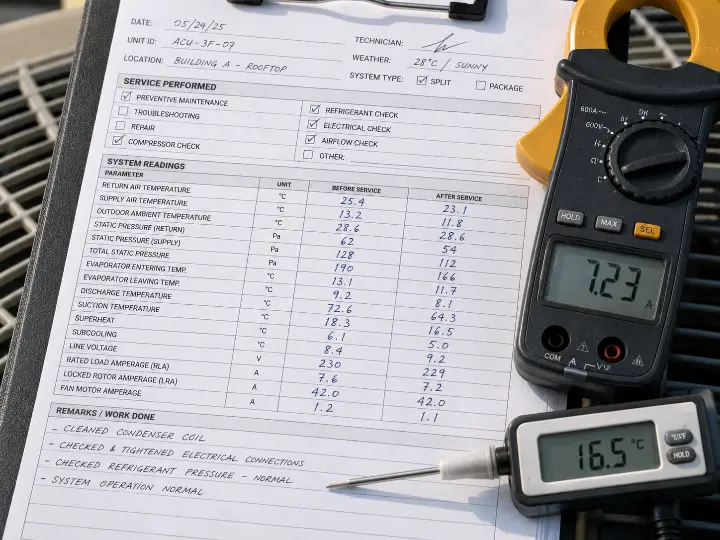
None of this means the technician did anything wrong. It means the report was built to confirm a visit happened, not to track a unit's condition thoroughly. Most programs only produce the first kind of document.
The fix is a different report. One with numbers instead of status words, and last visit's numbers next to them for comparison.
FIELD NOTE
Pull your last two reports and count the numbers on them. If you can count them on one hand, you have a receipt, not a record.