
Ask a property manager what failed on their last compressor replacement, and the answer is usually a normal explanation — "it just wore out," or "the compressor stopped." Ask the technician, and there's a decent chance the real story starts with a capacitor that had been quietly failing for a year.
A start or run capacitor gives a motor the extra push it needs to overcome inertia at startup, then to keep it running smoothly. It is rated in microfarads (µF), along with a tolerance — typically ±5% or ±6%. That rating degrades gradually as the dielectric inside breaks down from heat cycling and age.
A capacitor that has dropped 10-15% below its rated microfarad value doesn't stop the compressor motor from running. The compressor still starts — just harder, drawing more amperage than it should, on every single cycle. That elevated starting current heats the windings a little more each time. That is dangerous.
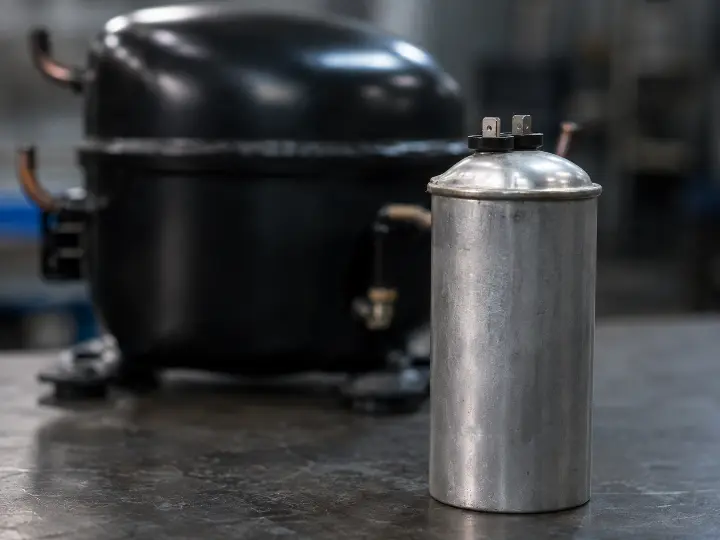
Fan motor capacitors fail the same way, with a quieter and worse symptom: a condenser fan that spins a little slower than it should, moving less air across the coil, raising head pressure, and making the compressor work harder on every cycle to reject the same heat load — a second failure in the compressor is brewing, due to the failing condenser fan motor capacitor.
The feedback loop: a weakening capacitor forces higher starting amperage, which generates more heat in the motor windings, which accelerates insulation breakdown. Eventually the compressor either fails to start at all, trips its internal overload repeatedly, or burns a winding outright — and the failure gets attributed to the compressor, not the small capacitor that caused it.
A technician checking this properly pulls the capacitor and tests it with a meter set to capacitance, comparing the reading against the stamped rating. Glancing at the can for the telltale bulge on top shows up once failure is already near.
It takes under two minutes. It also doesn't show up anywhere on a standard service report unless the technician writes the capacitor's reading.
For a property manager, the ask is simple: request the microfarad reading, not just "capacitor checked."