
Thorough coil cleaning can reduce compressor and circuit board stress by 20-50%. That is a big claim worth investigating. That number is real, but it's conditional. Understanding the mechanism is what lets a property manager tell the difference between a true service cleaning versus "surface cleaning".
The mechanism starts with heat exchange. Heat from the room is passed to the cold indoor evaporator coil. Coolness is then passed to the room air. Next, that heat from the outdoor condenser coil gets passed to the outside air. In turn, the condenser coil cools down.
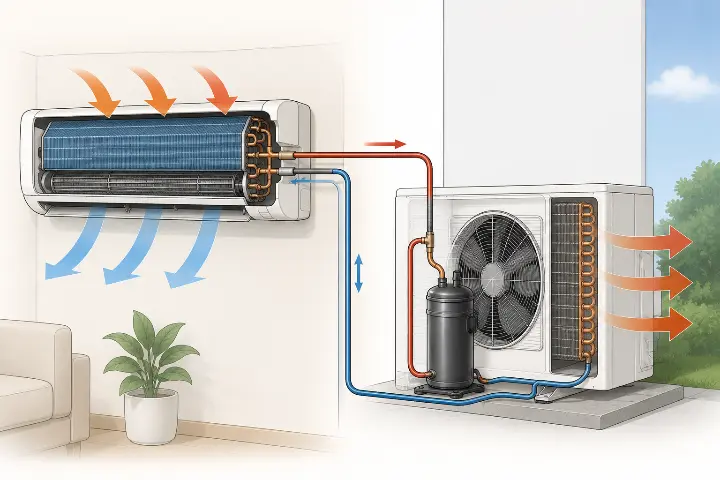
A compressor's job is to compress. It sucks and compresses the refrigerant from the indoor evaporator coil and pushes it to the outdoor condenser coil. Heat transfer happens across the surface area of both indoor and outdoor coils. Its muscle — the Intelligent Power Module (IPM) — drives and modulates this heat transfer.
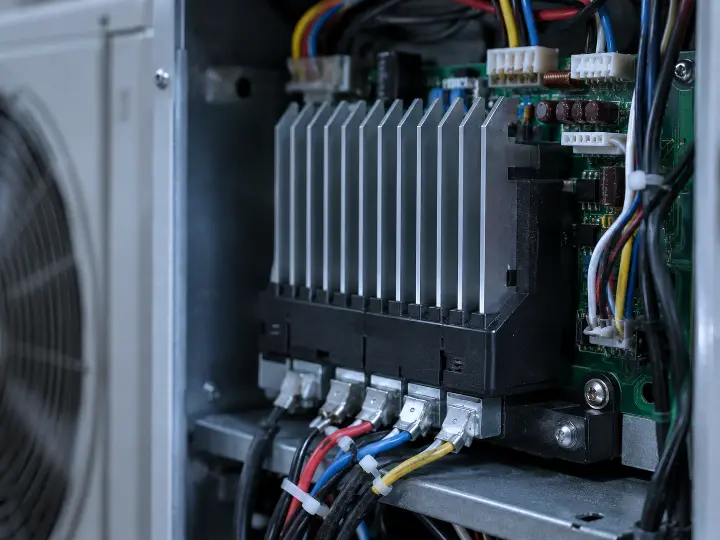
A layer of dust, grease, or biological film on the coil's surface — even a thin one, invisible from a few feet away — insulates or blocks this target heat exchange. The compressor does two things due to this thickening layer. It overworks or it underworks.
If it works harder, running longer cycles and operating at higher head pressure to move the same amount of heat through a partially insulated surface. That elevated mechanical work, sustained over months, is what accelerates internal wear.
It may also underwork. When room air heat cannot transfer to the evaporator coil due to the blockage, the refrigerant temperature goes lower. To prevent the indoor coil from freezing, the IPM pulls the compressor back or shuts it off. This creates short cycles in the compressor, and in its muscle — the IPM. Continued short cycles in the compressor and IPM cause unnecessary internal wear.
Each interruption is a jolt for the compressor and its IPM: a start, a stop, a swing in temperature. One jolt is nothing. Hundreds of them, accumulated over months, is fatigue. That's the slow road to "board failure."
Restoring the original heat exchange mechanism. This is where the distinction between a real cleaning and a surface rinse matters most. A coil fouled with grease, common in kitchen-adjacent QSR environments, or with fine dust that's built up over a full cooling season, doesn't come clean with a light rinse — the buildup sits between the fins, not just on their outer edge, and a rinse that clears the visible surface can leave the majority of the actual restriction in place.
Restoring heat exchange close to its original design efficiency requires cleaning to bare metal: a chemical treatment that breaks down the film, enough dwell time for it to work, and a rinse thorough enough to clear it from between the fins, not just off the front face. That's a materially different visit — in time, in chemicals, in labor.
Measuring compressor and IPM stress comes from metrics such as:
- head pressure
- discharge temperature
- ampere draw
- run-time under a standard load
before and after a coil is restored to near-original heat exchange efficiency from a significantly dirty state.
It's a real, measurable reduction, and it is one of the highest-leverage variables in a maintenance program. Coil fouling is predictable, visible on inspection, and directly correctable through labor and cleaning rather than parts.
For a property manager evaluating a maintenance contract, the question worth asking isn't whether cleaning happened, but how it was verified — whether the technician checked static pressure or discharge temperature before and after cleaning. This is the real evidence that heat exchange was actually restored rather than cosmetically improved.
A coil that looks clean from photos and a coil that's actually clean to the fin base have very different outcomes for the compressor and IPM running behind it.
The 20-50% belongs to the maintenance program that thoroughly cleans and measures.
Field Note
Ask your vendor for a before-and-after static pressure or discharge temperature reading on the next coil cleaning. If they can't produce one, there's no way to confirm the visit did more than make the coil look serviced.